Your Kitchen Is Already a Survival Cache: 3 Everyday Items That Could Save Your Life
When most people think about preparedness, their minds go to the garage, the basement, or the dedicated storage room with shelves of freeze-dried meals and water barrels. They picture the bug-out bag in the closet or the first-aid kit mounted on the wall. What they rarely picture is the room they stand in three times a day: the kitchen. Yet the kitchen is arguably the most survival-ready room in any home. It contains items that address fire, first aid, signaling, nutrition, lighting, and tool maintenance — all hiding in plain sight, purchased for mundane purposes, and overlooked by nearly everyone who hasn’t trained themselves to see differently. Three items in particular — baking soda, aluminum foil, and olive oil — deserve attention not because they are exotic or tactical, but because they are so ordinary that you already own them, already know how to use them, and can deploy them immediately in a crisis. This guide walks through the emergency applications of each, organized by function, so that the next time you open your pantry you see it for what it truly is: a survival cache that has been sitting there all along.
Baking Soda: The Multi-Purpose Powerhouse

Sodium bicarbonate occupies a humble box in most refrigerators, where it quietly absorbs odors until someone remembers to replace it. That modest role undersells the compound dramatically. Baking soda is one of the most versatile substances in household preparedness, and its applications span fire suppression, wound care, sanitation, and even tactical considerations that most preppers never think about.

Fire Suppression

Baking soda is a Class B and Class C fire suppressant, meaning it works on grease fires and electrical fires — the two types most likely to start in a kitchen. When heated above 158 degrees Fahrenheit, sodium bicarbonate decomposes and releases carbon dioxide, which smothers flames by displacing oxygen. This is the same chemical mechanism used in dry chemical fire extinguishers, just in a smaller, non-pressurized form. To use it, you simply throw generous handfuls at the base of the flames. Do not sprinkle it; you need enough volume to produce a meaningful CO2 release. A single standard box contains roughly one pound, which is sufficient for a stovetop grease fire if deployed immediately.

This matters because the most common response to a kitchen fire — grabbing water — is precisely the wrong move for a grease fire. Water sinks beneath burning oil, flashes to steam instantly, and sprays burning grease across the kitchen. A box of baking soda sitting on the counter or in the cabinet above the stove puts the correct response within arm's reach. For households that deep-fry or cook with high-heat oils regularly, keeping an open box of baking soda adjacent to the cooking surface is a low-cost, zero-maintenance safety measure that requires no training beyond "throw this on the fire."

Wound Care and First Aid

Sodium bicarbonate has mild antiseptic properties and, when mixed with clean water to form a paste, can serve as a field-expedient wound dressing in situations where commercial antiseptics are unavailable. The paste creates an alkaline environment that inhibits bacterial growth while also helping to draw out splinters, reduce itching from insect bites, and neutralize the discomfort of minor burns. A paste of three parts baking soda to one part water, applied to a bee sting or mosquito bite, provides noticeable relief within minutes — a fact that makes it worth carrying in a day-hike kit even when you are not preparing for anything more serious.

In a prolonged emergency where medical supplies run low, baking soda also serves as an oral rinse to reduce mouth bacteria and soothe canker sores, a foot soak for fungal issues, and a gentle exfoliant to help keep skin clean when bathing is infrequent. None of these uses replaces proper medical care, but they fill gaps when proper care is delayed or unavailable. The key advantage is that baking soda is inert, non-toxic, and nearly impossible to misuse in a way that causes harm, which is not true of many household chemicals pressed into improvised medical service.

Odor Control and SAR Considerations

The refrigerator deodorizing trick everyone knows has a less obvious application: controlling human scent in a wilderness or post-disaster environment. Search and rescue dogs track by scent, and in scenarios where you want to be found — lost hiker, post-earthquake trapped survivor — reducing competing odors can theoretically help dogs isolate your scent trail. Conversely, if you are in a situation where you do not want to be tracked by scent, controlling body odor, food odors, and waste odors becomes important, and baking soda is one of the few tools available without specialized equipment.

Sprinkling baking soda in footwear, on clothing stored in bags, and around latrine areas reduces the volatile organic compounds that produce detectable smells. It works on ammonia-based odors especially well, which includes urine and sweat. A small container of baking soda weighs almost nothing and can be packed into any kit without displacing more specialized gear.

Cleaning and Sanitation

In grid-down situations, sanitation becomes a leading cause of illness. Baking soda's mild abrasiveness and alkaline chemistry make it an effective cleaning agent for surfaces, cookware, and hands when soap is scarce. A paste of baking soda and water scrubs pots and pans without scratching them. Sprinkled into a greasy pan with a small amount of water and brought to a simmer, it loosens baked-on residue that would otherwise require steel wool and effort. For hand washing, a baking soda paste removes grime and neutralizes odors — it is not a disinfectant on its own, but it reduces the bacterial load mechanically, which is the same principle by which regular soap operates. Combined with a small amount of vinegar or lemon juice, which many kitchens also stock, it produces a fizzy cleaning reaction that increases mechanical removal of debris.


Aluminum Foil: The Shiny Swiss Army Knife

Aluminum foil lives in nearly every kitchen drawer, purchased in bulk and used mostly for lining baking sheets and wrapping leftovers. Stripped of that context, a sheet of aluminum foil is a thin, flexible, heat-resistant, highly reflective metal membrane — and those properties unlock a surprising number of survival functions.

Signaling and Rescue

The most dramatic use of aluminum foil is as an improvised signaling mirror. A sheet smoothed flat and aimed at the sun produces a flash visible for miles, far beyond the range of a whistle or shout. While a purpose-built signal mirror has a sighting grid that lets you aim the reflection precisely at a aircraft or distant search party, a sheet of foil can be wrapped around a piece of cardboard or a flat piece of bark to create a larger reflective surface than any commercial signal mirror provides. The larger reflective area makes it easier for rescuers to spot the flash even if your aim is imperfect.

To use it effectively, hold the foil with both hands, face the sun, and tilt the reflector until you see the bright spot of reflected light on the ground in front of you. Slowly raise it toward the horizon, sweeping across the area where you want the signal to land. Practice this once on a sunny day and you will understand the principle immediately. The foil weighs nothing and folds flat, making it an easy addition to any vehicle kit, daypack, or pocket survival tin.

Improvised Cooking

Aluminum foil's heat resistance makes it the original backcountry cooking tool. You can fashion it into a improvised pot for boiling water by folding and crimping the edges to form a watertight container, though it requires a supporting frame of green sticks to hold its shape over a fire. More practically, foil packets — the "hobo dinner" method — let you cook food directly in coals without cookware. Place chopped vegetables, protein, and a small amount of oil or water in the center of a sheet, fold the edges together tightly to seal, and place the packet at the edge of a bed of coals. In ten to fifteen minutes you have a steamed meal with no pot to clean.

A sheet of foil can also be folded into a windscreen for a camp stove, reflecting heat back toward the pot and dramatically improving fuel efficiency in windy conditions. Shaped into a parabolic curve and aimed at a pot suspended at the focal point, it can concentrate enough solar energy to warm water on a clear day — slow, but functional with patience, and it requires no fuel at all.

EMP Protection and Electronics Shielding

The Faraday cage properties of aluminum foil are frequently discussed in preparedness circles, often with more enthusiasm than precision. The physics is sound: a continuous conductive enclosure blocks electromagnetic fields, which is why sensitive electronics are shipped in anti-static bags that are essentially metalized plastic. Wrapping a small electronic device — a phone, a GPS unit, a handheld radio — in multiple layers of aluminum foil creates a poor man's Faraday cage that provides some degree of protection against electromagnetic interference.

The practical limitations are important to understand. For the foil to work, the device must be completely enclosed with no gaps, and the foil layers must not touch the device directly. Wrapping the device first in paper or cloth, then in foil, then in another insulating layer, then in foil again, improves effectiveness. Whether this would protect against a genuine high-altitude electromagnetic pulse from a nuclear detonation is a matter of debate among engineers, and the safe answer is that consumer-grade foil wrapping is better than nothing but not a guarantee. For the more likely scenario — protecting a backup drive from a nearby lightning strike or accidental exposure to a strong magnetic field — it is entirely adequate. The cost is zero dollars if you already have foil in your kitchen, and the knowledge costs nothing to keep in your mental toolkit.

Gear Repair and Improvisation

Heavy-duty aluminum foil can temporarily patch a hole in a tarp, a tear in a tent, or a cracked plastic container. It will not be waterproof under pressure, but it blocks wind, reflects heat, and keeps out debris. It can be shaped into a funnel for transferring liquids between containers. It can be crumpled into a scrubber for cleaning cookware or removing rust from tools. A small wad of foil placed under a loose battery in a flashlight or radio can restore electrical contact and get the device working again. These are small fixes, but small fixes are what keep a bad situation from becoming worse.


Olive Oil: Calories, Light, and Durability

Olive oil is the item on this list that surprises people most. It seems too mundane, too culinary, to belong in a discussion of emergency preparedness. But consider what olive oil is: a calorie-dense, shelf-stable lipid that requires no refrigeration, burns cleanly as fuel, has documented medicinal properties, and serves functions far beyond cooking.

Caloric Density and Emergency Nutrition

One tablespoon of olive oil contains approximately 120 calories, all from fat. In a situation where food is scarce and every calorie counts, that density is a strategic advantage. A single 500-milliliter bottle — the standard size in most kitchens — contains roughly 4,000 calories. That is two full days of energy for an adult at rest, in a container that fits in one hand and weighs just over a pound.

More importantly, fat is the macronutrient your body needs most during extended exertion in cold weather. Carbohydrates burn quickly; fat sustains. Adding a tablespoon of olive oil to any meal — rice, beans, pasta, soup — increases its caloric value meaningfully without adding bulk or requiring additional cooking fuel. The oil also helps your body absorb fat-soluble vitamins from whatever other food you are eating, improving nutritional efficiency at a time when efficiency matters.

Olive oil's shelf stability is another underappreciated characteristic. A sealed bottle stored in a cool, dark cabinet remains usable for 18 to 24 months past its production date. Opened, it lasts six to twelve months before quality noticeably degrades. Even rancid olive oil — while unpleasant to eat straight — is not dangerous in the way rancid meat is; it can still be burned as fuel or used for non-culinary purposes. Compare that to many preparedness foods that require rotation every few years, and olive oil holds its own as a legitimate storage staple.

Emergency Lighting

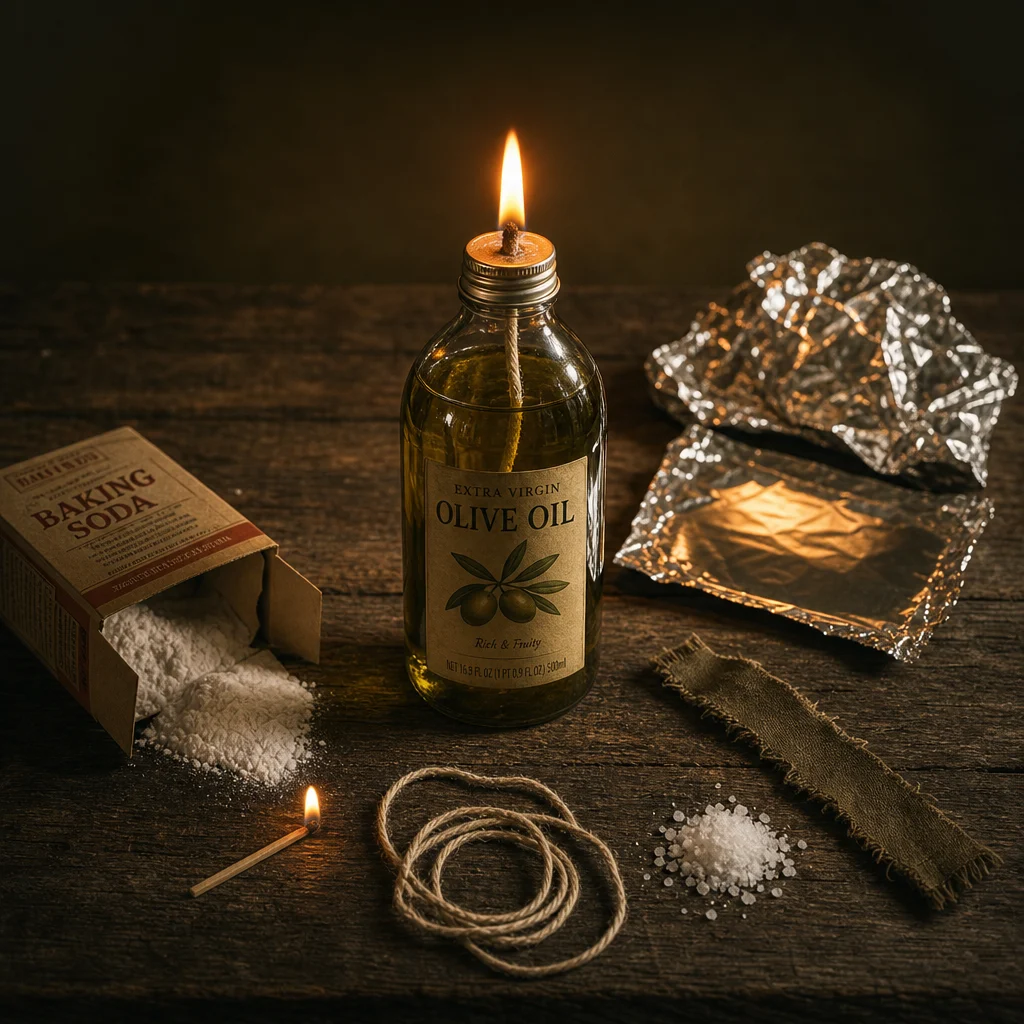
Olive oil burns. This fact, known to every civilization around the Mediterranean for thousands of years, is easily demonstrated: pour a shallow layer of oil into a heat-safe dish, set a wick — cotton string, a strip of cloth, even a twisted paper towel — so that one end sits in the oil and the other extends above the rim, and light it. The oil climbs the wick by capillary action and burns steadily at the tip, producing a flame roughly equivalent to a candle but with several advantages.

An olive oil lamp burns cleaner than a paraffin candle, producing almost no smoke or soot when the wick is properly trimmed. It cannot spill and ignite in the way that lamp oil or kerosene can, because olive oil has a high flash point — roughly 410 degrees Fahrenheit — meaning it will not ignite at room temperature even if a flame touches the surface of the oil directly. A single tablespoon of olive oil burns for approximately two hours, depending on wick thickness and flame size. A full bottle provides dozens of hours of light, which is more than most households keep in candles.

The practical setup is simple enough to make in five minutes with materials already in your kitchen: a small glass jar or ramekin, a piece of aluminum foil to fashion a wick holder that sits across the top of the jar with a hole punched in the center, and a cotton wick threaded through the hole into the oil. This is not bright enough to read by across the room, but it lights a small table, marks your location in the dark, and provides enough illumination to navigate a room without tripping.

First Aid and Skin Care

Olive oil has been used as a topical treatment for centuries, and modern research supports some of those traditional applications. It contains oleocanthal, a compound with anti-inflammatory properties comparable to low-dose ibuprofen. Applied to minor burns after cooling the affected area with water, it can help reduce pain and keep the skin moisturized during healing, though it should not be applied to a fresh, hot burn — cool the burn first with water, then apply oil once the heat has dissipated.

As a skin moisturizer and barrier, olive oil protects against chapping and windburn, conditions that become serious in cold or exposed environments where cracked skin invites infection. It can be used as a carrier oil for herbal preparations like plantain or comfrey poultices. For chapped lips, cracked heels, or dry hands caused by frequent washing in cold water with harsh soap, a few drops worked into the skin provide relief that no other kitchen ingredient can match. It is also an effective earwax softener: a drop of warm olive oil in each ear before bed helps loosen impacted wax, potentially restoring hearing that has been dulled by blockage.

Tool Maintenance and Rust Prevention

Carbon steel tools and cast iron cookware require a protective coating to prevent rust, especially in humid environments or when stored for extended periods. Olive oil works for this purpose. A thin layer wiped onto a knife blade, axe head, or cast iron skillet prevents oxygen from reaching the metal surface and oxidizing it. Unlike petroleum-based oils, olive oil is food-safe, so it can be used on cookware without any concern about chemical contamination. The oil will eventually polymerize and form a protective seasoning layer on cast iron, which is desirable. On tools that see frequent use, the oil coating lasts long enough to prevent rust between uses and is easily reapplied.


Beyond the Three: Building a Kitchen Preparedness Mindset

Baking soda, aluminum foil, and olive oil are not the only survival items hiding in a typical kitchen. They are the entry point to a way of looking at everyday objects that changes how you prepare. Once you start seeing every item through the lens of "what else can this do," the kitchen transforms.

What Else Is Already There

A few additional items worth re-evaluating: White vinegar is a disinfectant, a weed killer, and a descaling agent for water filters. Table salt preserves meat, cleans wounds in a saline solution, and kills slugs and snails that threaten a garden. Honey is antibacterial, essentially immortal in storage, and provides fast-absorbing sugar for treating hypoglycemia or shock. Coffee filters make excellent pre-filters for turbid water before boiling or chemical treatment. Plastic wrap and large trash bags serve as vapor barriers, improvised ponchos, water collectors via transpiration, and even short-term shelter components. None of this requires special purchases, and none of it adds weight to a storage system you are not already maintaining.

The Rotating Pantry Principle

The strategic advantage of kitchen-based preparedness is that the inventory rotates naturally. You buy baking soda because you bake. You buy olive oil because you cook. You use these items, replace them, and in the process maintain a stockpile that is always fresh, always familiar, and always ready. This is fundamentally different from purchasing freeze-dried meals that sit untouched for years and may never be tested under real conditions.

The principle extends beyond these three items. If you keep an extra bottle of olive oil on the shelf and rotate it — using the older one first, replacing it with a new one to the back — you maintain a buffer of stored calories with zero additional effort beyond slightly larger grocery purchases. The same applies to canned goods, pasta, rice, and other shelf-stable pantry staples. The preparedness system is invisible because it is integrated into daily life, and that invisibility is its greatest strength. It does not depend on remembering to check expiration dates on a dedicated storage shelf; it depends on cooking dinner.


Conclusion

Preparedness culture has a tendency to emphasize specialized gear — the right knife, the right fire starter, the right water filter — and while those tools have their place, they can also create the impression that preparedness is something you buy rather than something you build. The kitchen tells a different story. It says that the resources you need for a wide range of emergencies are already in your home, purchased for ordinary reasons, waiting to be seen differently. Baking soda handles fire, first aid, and sanitation. Aluminum foil handles signaling, cooking, and protection. Olive oil handles nutrition, light, and maintenance. Together they cost less than twenty dollars and cover an improbable range of scenarios without requiring any special storage, training, or maintenance.

The next time you stand in your kitchen, open the cabinet doors and look at the contents not as ingredients but as inventory. That box of baking soda is a fire extinguisher. That roll of foil is a signal mirror. That bottle of olive oil is a lamp and a medical supply. The shift is not in what you own but in how you see it. And once you make that shift, every kitchen becomes a survival cache — including yours.
Get the free Bug-Out Bag checklist
Join the list for instant access to printable preparedness downloads.