Baofeng Field Communications Manual: Repeaters, Antennas, Digital Modes & COMSEC

$37.00

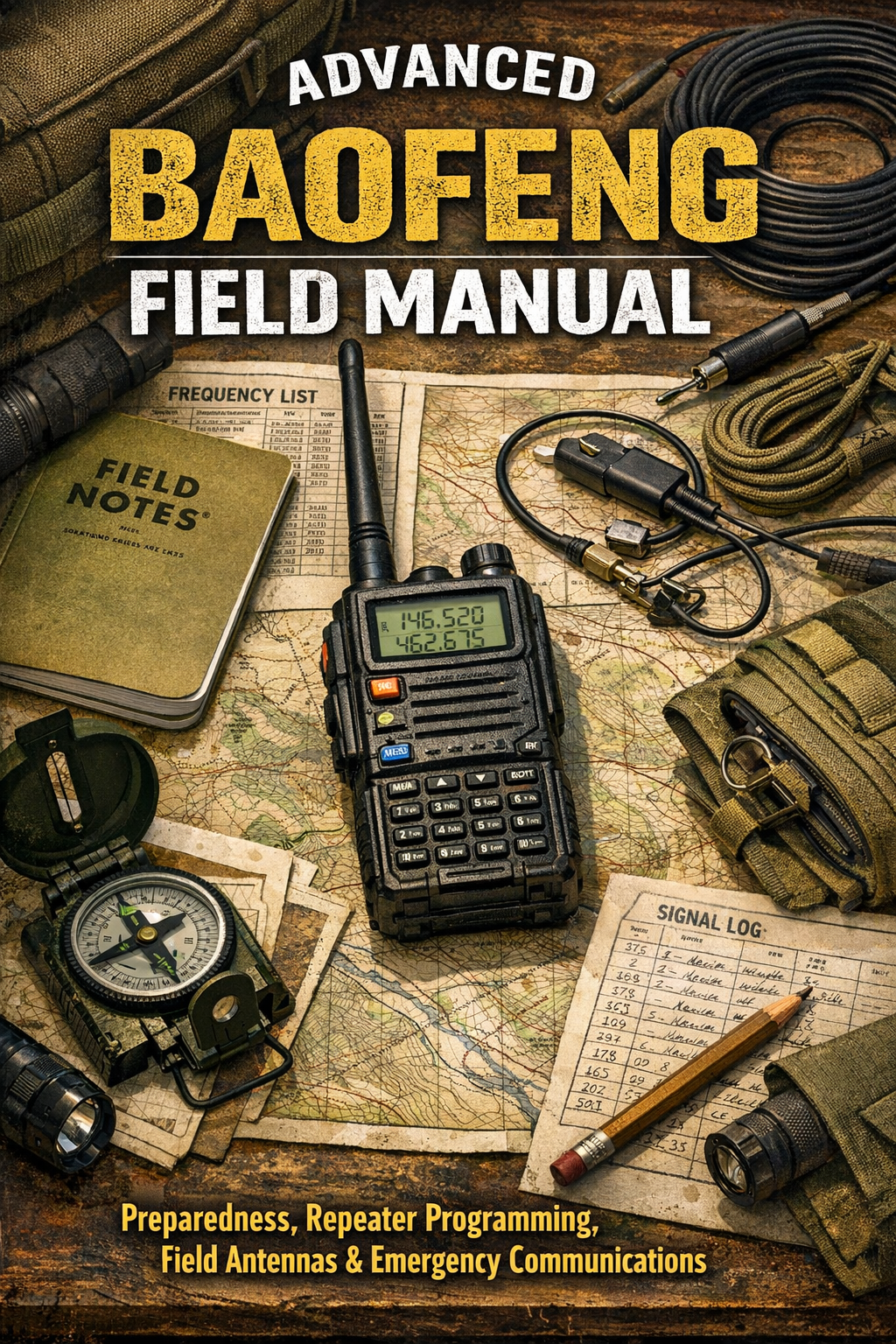
You know how to use your Baofeng. This manual teaches you how to deploy it. Covers repeaters that extend your range from 2 miles to 50+, improvised field antennas you can build from wire and a tree, digital modes for data transmission when voice isn’t enough, and the communications security techniques drawn from special operations practice — the same framework NC Scout brought to the civilian preparedness world. For the serious prepper, off-grid operator, and radio-minded survivalist. Instant PDF download.

Description

A radio is only as capable as the operator behind it.

Knowing how to turn it on and find a frequency is the beginning. What separates a prepper who can communicate in a disruption from one who can’t isn’t the radio — it’s the knowledge of how to employ it. Range, security, planning, reporting, and the ability to adapt when the infrastructure around you fails.

The Baofeng Field Communications Manual covers the layer of capability most guides never reach.


This manual is for you if:

You’ve mastered the basics and want to go further. You want to connect to repeaters and understand how they actually work — not just that they exist. You live in a rural area and need practical antenna options beyond the rubber duck that came in the box. You’re building a neighborhood or retreat communications network and need a planning framework. You want to understand what communications security means in practice, not in theory. You’re considering your ham Technician license and want to understand what it actually gets you. You’ve read NC Scout’s Guerrilla’s Guide to the Baofeng Radio and want a more structured reference built around the same operational framework.


What’s Inside — 7 Chapters

Chapter 1: The Three Roles of Field Communications

The foundational framework drawn from special operations practice: Sustainment (replacing your cell phone network), Tactical (immediate operational coordination), and Clandestine/Strategic (long-range, high-security). Every technical decision in this manual flows from understanding which role you’re operating in. The same Baofeng radio serves all three — what changes is how you configure and employ it.

Chapter 2: Repeaters — Multiplying Your Range

How repeaters work, what the offset and CTCSS tone mean and why you need both, step-by-step programming instructions for a 2-meter repeater from scratch, how to find repeaters near you, and why GMRS repeaters are often the right choice for prepper networks that don’t want to go through the ham licensing process. A Baofeng communicating through a well-placed repeater covers 30–100 miles on 5 watts.

Chapter 3: Field Antennas — Improvised and Upgraded

Three upgrade paths covered in full: the Nagoya NA-771 drop-in replacement (the best $15 you can spend on this radio), external magnetic-mount antennas for vehicle use, and field-expedient wire antennas you can build and deploy anywhere. The quarter-wave ground plane construction walkthrough includes the formula, the math for common prepper frequencies, and step-by-step assembly. The roll-up J-pole (Slim Jim) is covered as the go-bag antenna of choice. Antenna positioning is treated as an operational variable, not an afterthought.

Chapter 4: Communications Planning — Building an SOI

The Signal Operating Instructions (SOI) framework used by military and special operations units, adapted for civilian preparedness networks. Covers frequency schedules and rotation, communications windows and what a missed check-in means operationally, callsign assignment and how to avoid the intelligence failure of predictable hierarchy, the SARNEG authentication system for verifying who you’re actually talking to, grid encryption for location security, and challenge/password protocols for in-person link-ups. This chapter alone is worth the price of the manual for anyone running a multi-person network.

Chapter 5: Traffic Handling and Report Formats

The prowords that keep transmissions short and unambiguous. The SALUTE report for immediate intelligence handoff, with a real-world example drawn from operational use in Afghanistan. The ANGUS report for team insertion confirmation. The BORIS report for long-duration pattern-of-life intelligence. The 9-line MEDEVAC request — a format every serious operator should be able to send cold, under pressure, in under two minutes.

Chapter 6: Digital Modes, Encoding & COMSEC

What digital modes are available to a Baofeng operator and what each is actually good for: APRS for position tracking, Winlink for email over radio with no internet, VARA FM for data in a grid-down environment. Five COMSEC principles every Baofeng operator should build into their practice — including the counterintuitive one about not programming your tactical radio’s memory. The trigram encoding system for basic voice transmission security. Where these techniques protect you and where they don’t.

Chapter 7: Getting Your Ham Technician License

What the license actually gives you, what it doesn’t, the fastest study path (HamStudy.org plus KB6NU’s free study guide), how to find an exam session, and what the General class upgrade is worth for operators who want HF capability. Total cost is a $15 exam fee plus a $35 FCC application fee — about $50. No trick questions, no radio mythology.

Appendix: Essential Frequency Reference

A complete table covering every service relevant to a Baofeng operator — MURS, FRS, GMRS, 2-meter amateur, 70cm amateur, NOAA, marine, business band, and APRS — with license requirements clearly noted for each. Print it and keep it with the radio.


A note on sources

This manual synthesizes two bodies of knowledge that are rarely presented together: the practical Baofeng operating information from the amateur radio community, and the field communications doctrine from NC Scout’s Guerrilla’s Guide to the Baofeng Radio — the most operationally serious treatment of this radio available in the civilian market. The SOI framework, the three roles of communications, the report formats, and the COMSEC principles in this manual are grounded in that special operations lineage, not extrapolated from amateur radio convention.


What you get:

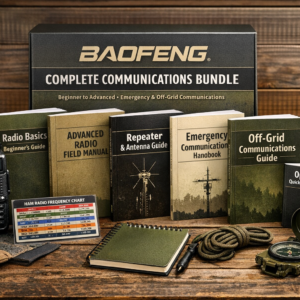
Comprehensive PDF manual — 7 chapters plus appendix. Complete frequency reference table covering all Baofeng-relevant services with license requirements. Report format quick-reference cards for SALUTE, ANGUS, BORIS, and MEDEVAC. Step-by-step antenna construction guides with calculated element lengths for common prepper frequencies. Compatible with all UV-5R variants and most other Baofeng dual-band radios. Instant download — available immediately after purchase.

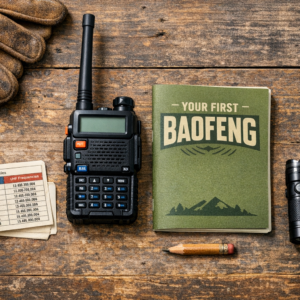
This manual is part of the Foundations of Personal Preparedness program at Survival Technician. It builds directly on Your First Baofeng — if you haven’t read that one yet, start there.


⚠ Legal note: Transmitting on many frequencies covered in this manual requires an FCC amateur radio license. Monitoring and receiving require no license. Where COMSEC techniques have legal implications, they are presented for academic and preparedness education purposes.

Reviews

There are no reviews yet.

Be the first to review “Baofeng Field Communications Manual: Repeaters, Antennas, Digital Modes & COMSEC”

Your email address will not be published. Required fields are marked *